In July 2026, the U.S. Department of State revised the Duration of Status (D/S) system, which had previously allowed individuals admitted under F-1 student, J-1 exchange visitor, and I media visas to remain in the United States as long as they maintained their respective visa status. Under the revised system, these visa holders may remain in the United States only for a specified period of time.
Key Changes for F-1 Student Visas and J-1 Exchange Visitor Visas
- F-1 and J-1 visa holders may remain in the United States for a maximum of four years.
- The four-year period begins not from the date the foreign national enters the United States, but from the program start date listed on Form I-20 or Form DS-2019.
- The period during which an individual may enter the United States up to 30 days before the program start date, as well as the grace period following completion of the program, is not included in the four-year maximum period.
- The F-1 grace period is reduced from 60 days to 30 days.
- Students who discontinue their studies must depart the United States within 30 days.
- Before transferring to another school, a student must study for at least one year at the school that issued the student’s I-20.
- Graduate students may not change their field of study and, except in special circumstances, may not transfer to another school.
- Students may not enroll in a degree program at a lower educational level than the highest degree they have earned in the United States. For example, a student who has earned a bachelor’s degree in the United States may enroll only in a master’s or doctoral program in the United States.
- English-language training is limited to a total of 24 months.
Key Changes for I Media Visas
- I visa holders may remain in the United States for a maximum of 240 days (90 days for journalists who are Chinese nationals).
- Applications to extend the period of stay in the United States are permitted.
U.S. Court of Appeals Upholds Decision Striking Down $100,000 H-1B Visa Application Fee
A U.S. federal court of appeals in Boston upheld a federal district court decision finding that the Trump administration’s increase of the H-1B visa application fee to $100,000 for foreign nationals residing outside the United States constituted an unlawful tax.
As a result, U.S. employers are no longer required to pay the $100,000 application fee when applying for H-1B visas for foreign nationals residing outside the United States. However, if the Trump administration appeals the case to the U.S. Supreme Court, the outcome could change depending on the Supreme Court’s final decision.
FY 2027 H-1B Visa Cap Reached
In July 2026, U.S. Citizenship and Immigration Services (USCIS) announced that it had reached the FY 2027 H-1B visa cap of 85,000 visas, consisting of 65,000 under the regular cap and 20,000 for individuals holding a U.S. master’s degree or higher.
As a result, USCIS will not conduct a second H-1B lottery for applicants who were not selected in the initial H-1B lottery conducted in late March.
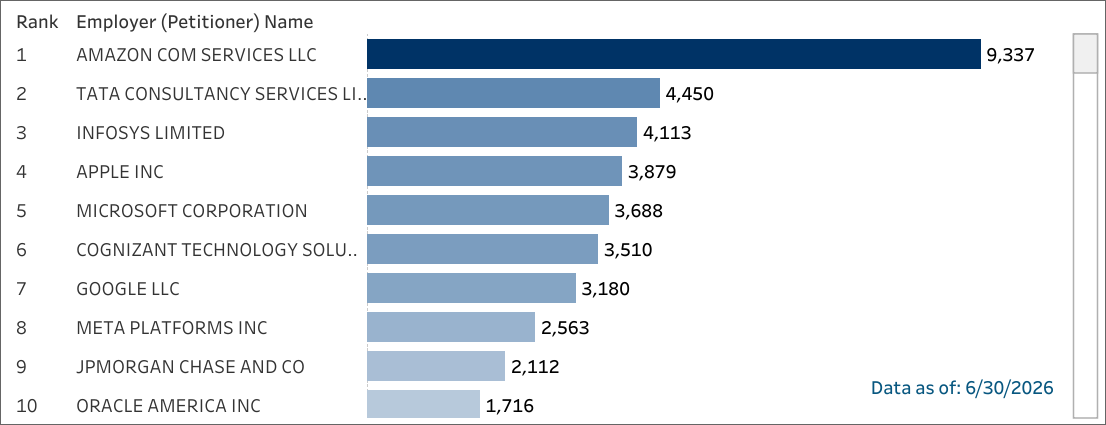 Ranking of U.S. Employers Filing FY 2027 H-1B Petitions
If you were not selected in the H-1B lottery, you may consider other visa categories. In particular, recent college graduates may consider the following alternatives:
- O-1B visa for individuals in the arts (designers, musicians, chefs, etc.)
- E-1 or E-2 employee visa
- J-1 trainee or J-1 intern visa
President Trump Signs New Executive Order to Restrict Birth Tourism
Earlier this year, President Trump signed an executive order seeking to suspend the constitutional principle that automatically grants U.S. citizenship to children born in the United States to parents who are neither U.S. citizens nor lawful permanent residents. However, in June, the U.S. Supreme Court ruled that, with very limited exceptions such as children of diplomats, all persons born in the United States have a right to U.S. citizenship under the Fourteenth Amendment, thereby blocking the executive order.
In August 2026, President Trump signed a new executive order that partially restricts the acquisition of U.S. citizenship by individuals born in the United States.
Under the new executive order, U.S. citizenship is restricted in cases involving:
- Children born in the United States to parents from countries designated as state sponsors of terrorism
- Children born in the United States to employees of foreign government agencies, diplomats, embassies, or international organizations
- Children born in the United States through unlawful birth-tourism arrangements
USCIS Adjustment of Status Delays Increase Wait Times for Green Cards
Recently, the time required to obtain lawful permanent resident status through adjustment of status in the United States has increased compared with the past.
For example, in previous cases handled by LawAmerica involving the EB-1 employment-based first-preference category—including EB-1A (individuals of extraordinary ability in the sciences, arts, education, business, or athletics), EB-1B (outstanding professors and researchers), and EB-1C (multinational executives and managers)—Form I-485 adjustment of status applications were approved as quickly as three months, and generally within five to six months after approval of the Form I-140 immigrant petition.
Recently, however, processing times for EB-1 Form I-485 adjustment of status applications have increased. Following the beginning of the second Trump administration, additional regulations restricting eligibility for permanent residence appear to have increased USCIS’s workload.
During the Biden administration, the enhanced Public Charge requirements that had been applied to Form I-485 adjustment of status applications during the first Trump administration were eliminated. However, USCIS has announced plans to strengthen public charge requirements again beginning in September 2026. If additional public charge requirements are added to Form I-485, applicants will likely be required to submit additional documentation. Therefore, applicants who are eligible to file for adjustment of status may benefit from proceeding as soon as possible.


Many students who have applied for F-1 student visas to attend U.S. colleges and graduate schools this fall semester are experiencing delays in visa issuance due to social media screening and other enhanced review procedures.
With so much to prepare for the new semester, including booking flights to the United States and arranging housing, it is unfortunate to see students anxiously waiting for their student visas to be issued.
We wish all international students success in obtaining their visas. LawAmerica will also continue to do its utmost to help our clients successfully obtain their U.S. visas or green cards.
Sincerely,
LAWAMERICA
Student Visas / Exchange Visitor Visas / Media Visas: Elimination of Duration of Status
In July 2026, the U.S. Department of State revised the Duration of Status (D/S) system, which had previously allowed individuals admitted under F-1 student, J-1 exchange visitor, and I media visas to remain in the United States as long as they maintained their respective visa status. Under the revised system, these visa holders may remain in the United States only for a specified period of time.
Key Changes for F-1 Student Visas and J-1 Exchange Visitor Visas
Key Changes for I Media Visas
U.S. Court of Appeals Upholds Decision Striking Down $100,000 H-1B Visa Application Fee
A U.S. federal court of appeals in Boston upheld a federal district court decision finding that the Trump administration’s increase of the H-1B visa application fee to $100,000 for foreign nationals residing outside the United States constituted an unlawful tax.
As a result, U.S. employers are no longer required to pay the $100,000 application fee when applying for H-1B visas for foreign nationals residing outside the United States. However, if the Trump administration appeals the case to the U.S. Supreme Court, the outcome could change depending on the Supreme Court’s final decision.
FY 2027 H-1B Visa Cap Reached
In July 2026, U.S. Citizenship and Immigration Services (USCIS) announced that it had reached the FY 2027 H-1B visa cap of 85,000 visas, consisting of 65,000 under the regular cap and 20,000 for individuals holding a U.S. master’s degree or higher.
As a result, USCIS will not conduct a second H-1B lottery for applicants who were not selected in the initial H-1B lottery conducted in late March.
If you were not selected in the H-1B lottery, you may consider other visa categories. In particular, recent college graduates may consider the following alternatives:
President Trump Signs New Executive Order to Restrict Birth Tourism
Earlier this year, President Trump signed an executive order seeking to suspend the constitutional principle that automatically grants U.S. citizenship to children born in the United States to parents who are neither U.S. citizens nor lawful permanent residents. However, in June, the U.S. Supreme Court ruled that, with very limited exceptions such as children of diplomats, all persons born in the United States have a right to U.S. citizenship under the Fourteenth Amendment, thereby blocking the executive order.
In August 2026, President Trump signed a new executive order that partially restricts the acquisition of U.S. citizenship by individuals born in the United States.
Under the new executive order, U.S. citizenship is restricted in cases involving:
USCIS Adjustment of Status Delays Increase Wait Times for Green Cards
Recently, the time required to obtain lawful permanent resident status through adjustment of status in the United States has increased compared with the past.
For example, in previous cases handled by LawAmerica involving the EB-1 employment-based first-preference category—including EB-1A (individuals of extraordinary ability in the sciences, arts, education, business, or athletics), EB-1B (outstanding professors and researchers), and EB-1C (multinational executives and managers)—Form I-485 adjustment of status applications were approved as quickly as three months, and generally within five to six months after approval of the Form I-140 immigrant petition.
Recently, however, processing times for EB-1 Form I-485 adjustment of status applications have increased. Following the beginning of the second Trump administration, additional regulations restricting eligibility for permanent residence appear to have increased USCIS’s workload.
During the Biden administration, the enhanced Public Charge requirements that had been applied to Form I-485 adjustment of status applications during the first Trump administration were eliminated. However, USCIS has announced plans to strengthen public charge requirements again beginning in September 2026. If additional public charge requirements are added to Form I-485, applicants will likely be required to submit additional documentation. Therefore, applicants who are eligible to file for adjustment of status may benefit from proceeding as soon as possible.