
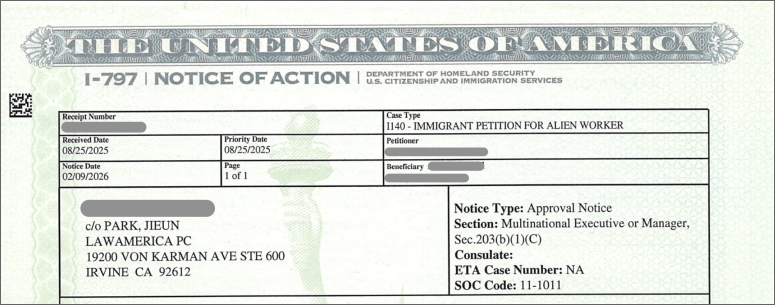
Our client, a multinational company manager who was working at a U.S. office in E-2 status, filed an EB-1C immigrant petition under the first-preference employment-based immigration category while in the United States. The petition was approved.
Based on its experience and expertise handling a variety of cases, LawAmerica has maintained a 100% approval rate for EB-1C petitions to date.
💡 EB-1C First-Preference U.S. Permanent Residence for Multinational Executives and Managers
For EB-1C, the first-preference employment-based permanent residence category, the revenue and number of employees of the Korean and U.S. companies, as well as the applicant’s experience managing employees, are important factors in the adjudication.
When the companies have relatively limited revenue and few employees, the likelihood of approval may be lower, making it important to work with an experienced U.S. immigration attorney.
💡 LawAmerica Case Result
In this case, the client had been working as a team leader at an affiliate of a major Korean conglomerate, took office as head of the company's new U.S. branch on an E-2 visa, and then retained us for the green card application.
Although one year had passed since the U.S. entity was established, first-year revenue had fallen short of initial projections, and local hiring was also behind plan. Another law firm the client had previously consulted opined that the chances of EB-1C approval were low and recommended proceeding under the employment-based second preference (EB-2) instead.
The EB-2 process (except for NIW), which includes the labor certification procedure, takes a considerable amount of time through to final green card issuance. The EB-1C, by contrast, requires no labor certification, and if the priority date is current after petition approval, the green card application can proceed immediately without any separate waiting period.
LawAmerica comprehensively analyzed the parent-subsidiary relationship between the Korean headquarters and the U.S. entity, the organizational charts of the Korean and U.S. offices, the client's job duties and scope of authority, the substance of their actual management activities, and future business expansion plans, and prepared the petition strategically. The EB-1C petition received final approval.
The client plans to obtain permanent residency through the adjustment of status process within the United States.
Professionals


Our client, a multinational company manager who was working at a U.S. office in E-2 status, filed an EB-1C immigrant petition under the first-preference employment-based immigration category while in the United States. The petition was approved.
Based on its experience and expertise handling a variety of cases, LawAmerica has maintained a 100% approval rate for EB-1C petitions to date.
💡 EB-1C First-Preference U.S. Permanent Residence for Multinational Executives and Managers
For EB-1C, the first-preference employment-based permanent residence category, the revenue and number of employees of the Korean and U.S. companies, as well as the applicant’s experience managing employees, are important factors in the adjudication.
When the companies have relatively limited revenue and few employees, the likelihood of approval may be lower, making it important to work with an experienced U.S. immigration attorney.
💡 LawAmerica Case Result
In this case, the client had been working as a team leader at an affiliate of a major Korean conglomerate, took office as head of the company's new U.S. branch on an E-2 visa, and then retained us for the green card application.
Although one year had passed since the U.S. entity was established, first-year revenue had fallen short of initial projections, and local hiring was also behind plan. Another law firm the client had previously consulted opined that the chances of EB-1C approval were low and recommended proceeding under the employment-based second preference (EB-2) instead.
The EB-2 process (except for NIW), which includes the labor certification procedure, takes a considerable amount of time through to final green card issuance. The EB-1C, by contrast, requires no labor certification, and if the priority date is current after petition approval, the green card application can proceed immediately without any separate waiting period.
LawAmerica comprehensively analyzed the parent-subsidiary relationship between the Korean headquarters and the U.S. entity, the organizational charts of the Korean and U.S. offices, the client's job duties and scope of authority, the substance of their actual management activities, and future business expansion plans, and prepared the petition strategically. The EB-1C petition received final approval.
The client plans to obtain permanent residency through the adjustment of status process within the United States.
Professionals