
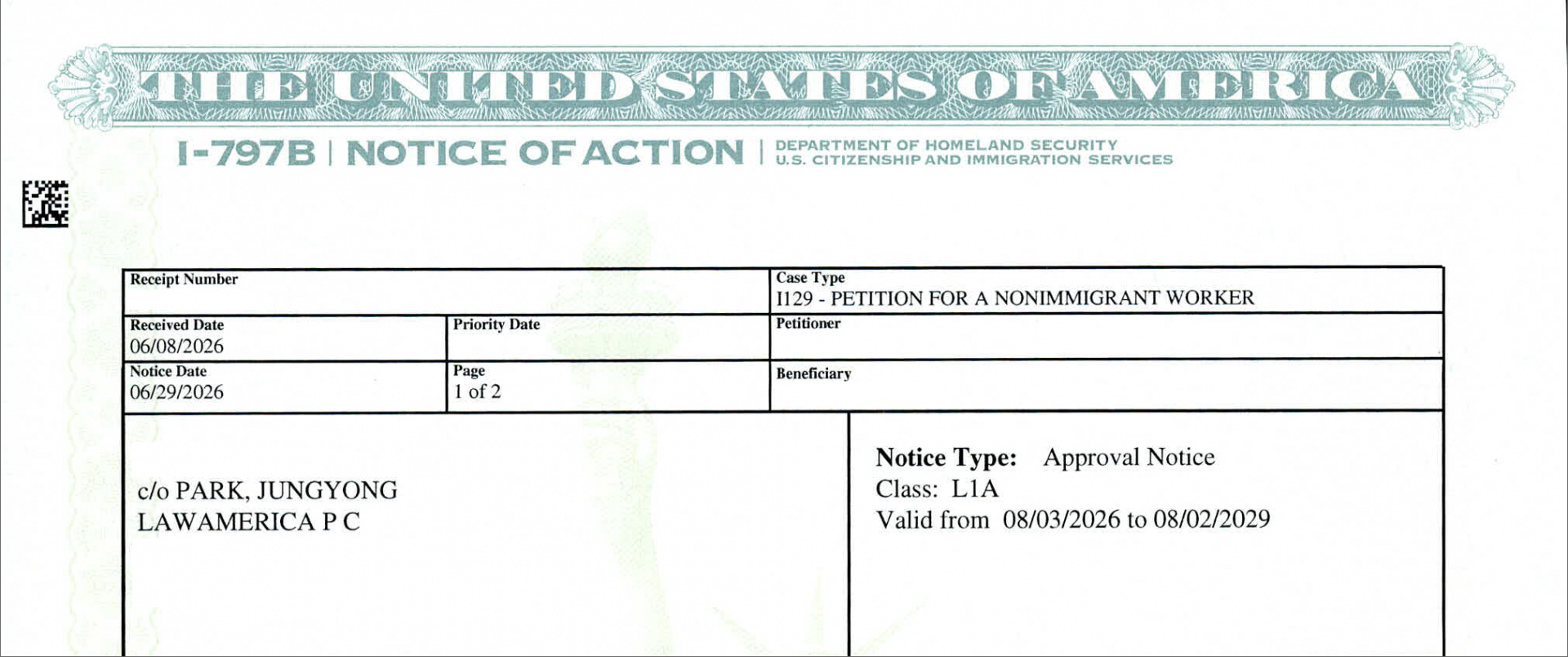
This is a case in which an L-1A intracompany transferee visa petition was filed and approved in order to assign an executive from the Korean headquarters to its U.S. subsidiary.
1. Case Overview
- Visa type: L-1A intracompany transferee visa for managers and executives
- Applicant: An executive of a Korean company (the "Client")
- Result: The Form I-129 L-1A petition was filed via Premium Processing and approved in 15 days without a Request for Evidence (RFE)
2. Case Background
The Client had worked at the Korean headquarters for over 18 years and had played a leading role in establishing the U.S. subsidiary and hiring local staff.
In 2024, the Client applied through another law firm for an E-2 employee visa in order to take office as head of the U.S. subsidiary, but the application was denied and a re-application filed several months later was denied again.
Then, in 2025, an L-1 intracompany transferee visa petition was filed with U.S. Citizenship and Immigration Services (USCIS) through yet another law firm, but that petition was also denied.
The Client was in such a difficult position that they had all but given up on the U.S. subsidiary assignment. However, after reviewing LawAmerica’s L-1 visa approval track record, the Client retained LawAmerica to re-file the L-1 petition.
After approximately 2 months of thorough document preparation, the petition was filed via Premium Processing and was approved in about 3 weeks without a Request for Evidence (RFE). The Client is now scheduled to attend a visa interview at the U.S. Embassy in Seoul.
3. Points to Note
If an E-2 employee visa application filed through a U.S. embassy has been denied two or more times, considering an L-1 intracompany transferee visa can be an alternative worth exploring, rather than repeatedly re-applying for the same visa.
For an E-2 employee visa, the consular officer at the U.S. embassy makes the final decision on visa issuance. In contrast, for an L-1 visa, USCIS first reviews and approves the petition, after which the visa interview takes place. Accordingly, once USCIS has approved the petition, the embassy generally does not re-adjudicate and overturn that approval.
For these reasons, even in cases, where an E-2 employee visa has been denied multiple times, there may still be a possibility of approval through an L-1 intracompany transferee visa, based on a comprehensive review of the applicant’s career history, job duties, and the status of the company’s U.S. business operations.
Professionals


This is a case in which an L-1A intracompany transferee visa petition was filed and approved in order to assign an executive from the Korean headquarters to its U.S. subsidiary.
1. Case Overview
2. Case Background
The Client had worked at the Korean headquarters for over 18 years and had played a leading role in establishing the U.S. subsidiary and hiring local staff.
In 2024, the Client applied through another law firm for an E-2 employee visa in order to take office as head of the U.S. subsidiary, but the application was denied and a re-application filed several months later was denied again.
Then, in 2025, an L-1 intracompany transferee visa petition was filed with U.S. Citizenship and Immigration Services (USCIS) through yet another law firm, but that petition was also denied.
The Client was in such a difficult position that they had all but given up on the U.S. subsidiary assignment. However, after reviewing LawAmerica’s L-1 visa approval track record, the Client retained LawAmerica to re-file the L-1 petition.
After approximately 2 months of thorough document preparation, the petition was filed via Premium Processing and was approved in about 3 weeks without a Request for Evidence (RFE). The Client is now scheduled to attend a visa interview at the U.S. Embassy in Seoul.
3. Points to Note
If an E-2 employee visa application filed through a U.S. embassy has been denied two or more times, considering an L-1 intracompany transferee visa can be an alternative worth exploring, rather than repeatedly re-applying for the same visa.
For an E-2 employee visa, the consular officer at the U.S. embassy makes the final decision on visa issuance. In contrast, for an L-1 visa, USCIS first reviews and approves the petition, after which the visa interview takes place. Accordingly, once USCIS has approved the petition, the embassy generally does not re-adjudicate and overturn that approval.
For these reasons, even in cases, where an E-2 employee visa has been denied multiple times, there may still be a possibility of approval through an L-1 intracompany transferee visa, based on a comprehensive review of the applicant’s career history, job duties, and the status of the company’s U.S. business operations.
Professionals